Basketball Betting Glossary: Market Terms and Definitions
 Available in US
The first time someone mentioned “taking the hook” in a basketball betting discussion, I nodded along while privately confused. Half-point differences seemed trivially small in a sport where teams score over 200 combined points. Then I watched my spread lose by exactly 0.5 points and understood why terminology precision matters. Basketball betting has its own vocabulary, and fluency in that language is prerequisite to participation.
This glossary covers essential terms for UK bettors entering basketball markets. The vocabulary spans betting mechanics, odds formats, basketball-specific concepts, and industry terminology that appears across operator platforms and betting discussions.
Core Betting Terms
Accumulator — A single bet combining multiple selections where all must win for the bet to pay. Also called a parlay or multi. Accumulators offer higher potential returns but lower probability than individual bets.
Against the spread (ATS) — Performance relative to the point spread rather than outright win/loss. A team that wins by 3 when favoured by 7 loses ATS despite winning the game.
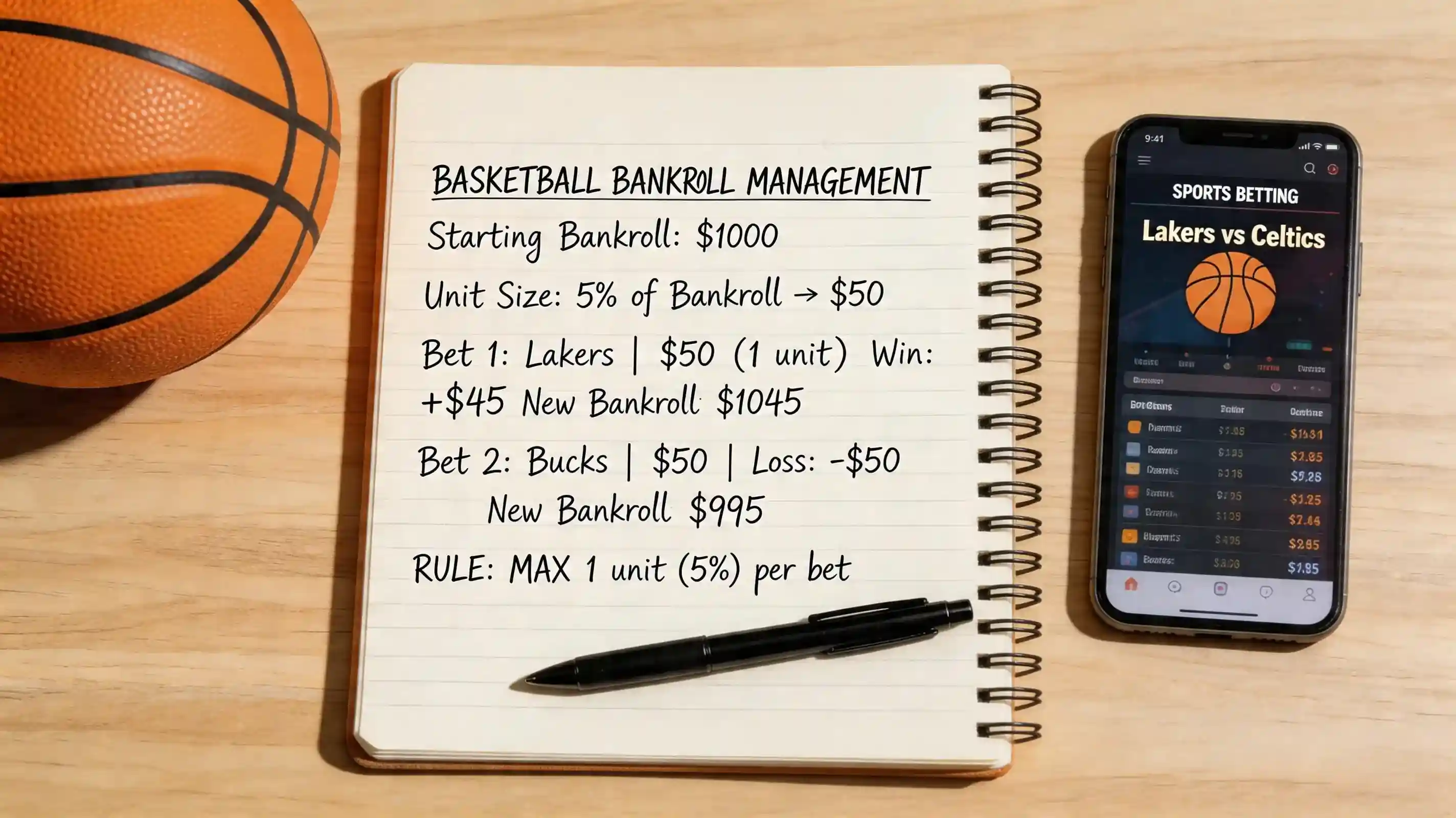
Bankroll — The total amount of money allocated for betting. Proper bankroll management involves sizing bets as consistent percentages of this total.
Closing line — The final odds available before a game begins. Consistently beating the closing line indicates genuine betting skill.
Cover — When a team beats the spread. A favourite covering means they won by more than the spread; an underdog covering means they lost by less than the spread or won outright.
Edge — The bettor’s advantage over the market’s implied probability. Positive edge indicates expected profit; negative edge indicates expected loss.
Handle — The total amount of money wagered on an event or market. High-handle markets tend toward greater efficiency.
Juice — The commission taken by bookmakers, also called vig or vigorish. Standard juice on spreads is -110 on both sides, meaning bettors must risk 110 to win 100.
Line — The odds or spread offered on a particular bet. Line movement refers to changes in these odds over time.
Push — When the result exactly matches the spread, resulting in stakes being returned with no win or loss.
Sharp — A sophisticated bettor whose action moves lines. Sharps typically bet larger amounts based on mathematical analysis rather than fan preference.
Square — A recreational bettor who typically bets based on fandom or casual analysis rather than systematic approach.
Basketball-Specific Terms
Back-to-back — Games played on consecutive days. Research shows measurable performance decline in back-to-back situations, affecting spreads and totals.
Garbage time — Late-game minutes when outcomes are effectively decided and starters rest. Garbage time scoring affects final margins but not competitive results.
Pace — The number of possessions a team uses per game. High-pace teams create more scoring opportunities, affecting totals projections.
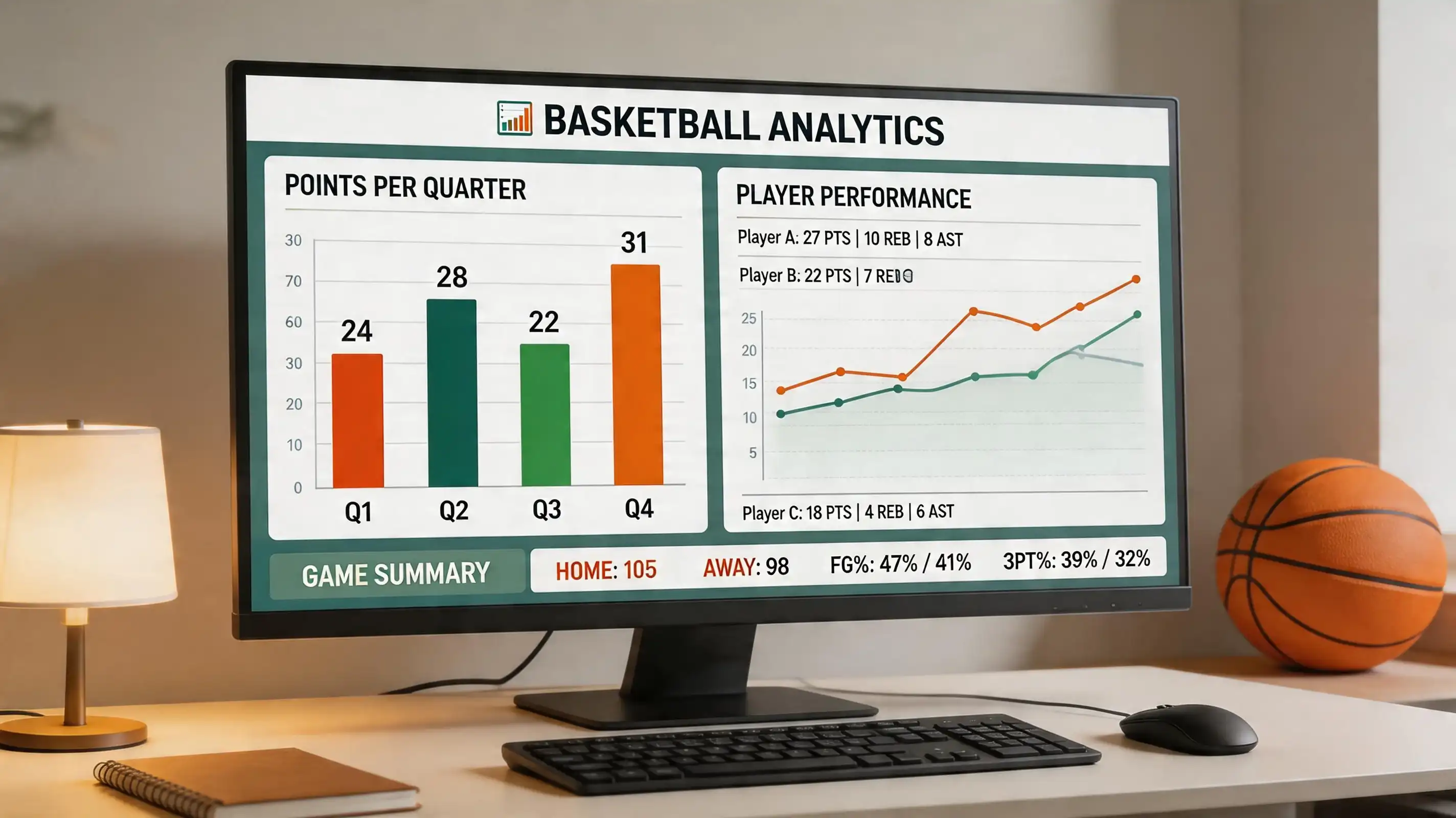
Player efficiency rating (PER) — A per-minute rating that summarises a player’s statistical contributions. Useful for assessing player impact on team performance.
Rest advantage — The difference in days off between competing teams. Significant rest advantages correlate with improved performance.
Schedule spot — A game’s context within the broader schedule. Games before rivalries, after long trips, or during dense stretches create predictable motivational patterns.
True shooting percentage — A shooting efficiency metric accounting for three-pointers and free throws. More accurate than field goal percentage for assessing offensive efficiency.
Market Types
Moneyline — A bet on which team wins outright, regardless of margin. Expressed in decimal, fractional, or American odds formats.
Point spread — A handicap applied to level the playing field between favourites and underdogs. The favourite must win by more than the spread; the underdog must lose by less or win outright.
Totals (over/under) — A bet on whether combined scoring exceeds or falls below a set number. Team totals bet on individual team scoring rather than combined.
First-half and first-quarter lines — Spread and total lines for partial-game outcomes. These markets settle at halftime or quarter end rather than game end.
Player props — Bets on individual player statistical outcomes: points, rebounds, assists, three-pointers, and combinations thereof.
Same game parlay (SGP) — An accumulator combining multiple selections from the same game. Correlation between selections affects pricing. Research indicates 92% of new platform customers create their first SGP within three minutes of signup.
Live betting — Wagering during games with odds that update continuously. Also called in-play or in-game betting. Live betting comprises the majority of total betting volume globally.
Futures — Long-term bets on outcomes like championship winners, MVP awards, or season win totals. Futures tie up capital for extended periods but offer substantial odds.
Odds Formats
Decimal odds — The total return per unit staked, including stake. 2.50 means a winning bet returns 2.50 for every 1.00 wagered (1.50 profit plus 1.00 stake returned).
Fractional odds — Traditional UK format showing profit relative to stake. 3/1 means 3 units profit for every 1 unit staked. 1/2 means 1 unit profit for every 2 units staked.
American odds — US format using plus and minus notation. +150 means 150 profit on 100 stake; -150 means 100 profit requires 150 stake. Commonly used for NBA markets.
Implied probability — The win probability suggested by odds. Convert decimal odds by dividing 1 by the odds: 2.00 implies 50% probability; 1.50 implies 66.7% probability.
The hook — A half-point added to spreads or totals to eliminate push possibilities. Taking the hook means accepting worse odds for the half-point cushion.
Industry Terms
Cash out — Settling a bet before the event concludes at current market value. Available on many live and pre-game bets.
Limits — Maximum bet amounts accepted by operators. Successful bettors often face reduced limits as operators manage risk.
Odds movement — Changes in betting lines between opening and closing. Tracking movement reveals where sharp money and public money diverge.
Steam move — Rapid, significant line movement caused by coordinated sharp betting. Steam moves signal professional consensus about value.
Reverse line movement — When lines move opposite to the direction public betting would suggest. Indicates sharp money opposing public consensus.
Wiseguy — Another term for a sharp or professional bettor. Wiseguy action typically moves markets.
For practical application of these concepts to live betting scenarios, live basketball betting fundamentals demonstrates how terminology translates into actionable strategy.
What does ‘covering the spread’ mean in basketball betting?
Covering the spread means a team performed better than the point spread required. For favourites, this means winning by more than the spread number. For underdogs, this means losing by less than the spread or winning outright. A team can win the game but fail to cover if the margin is smaller than the spread.
What is the difference between moneyline and spread betting?
Moneyline betting predicts which team wins outright regardless of margin. Spread betting applies a handicap where favourites must win by more than the spread and underdogs must lose by less or win. Moneylines offer larger payouts on underdogs; spreads create approximately 50-50 propositions with similar odds on both sides.
What does ‘the hook’ mean in basketball betting?
The hook refers to the half-point in spreads and totals. A spread of -7.5 includes the hook; -7 does not. The hook eliminates push possibilities where exact outcomes return stakes. Taking the hook means accepting worse odds for the half-point cushion that prevents pushes.
Prepared by the Live Basketball Betting editorial staff.