Basketball Bankroll Management: Staking Plans and Unit Sizing
 Available in US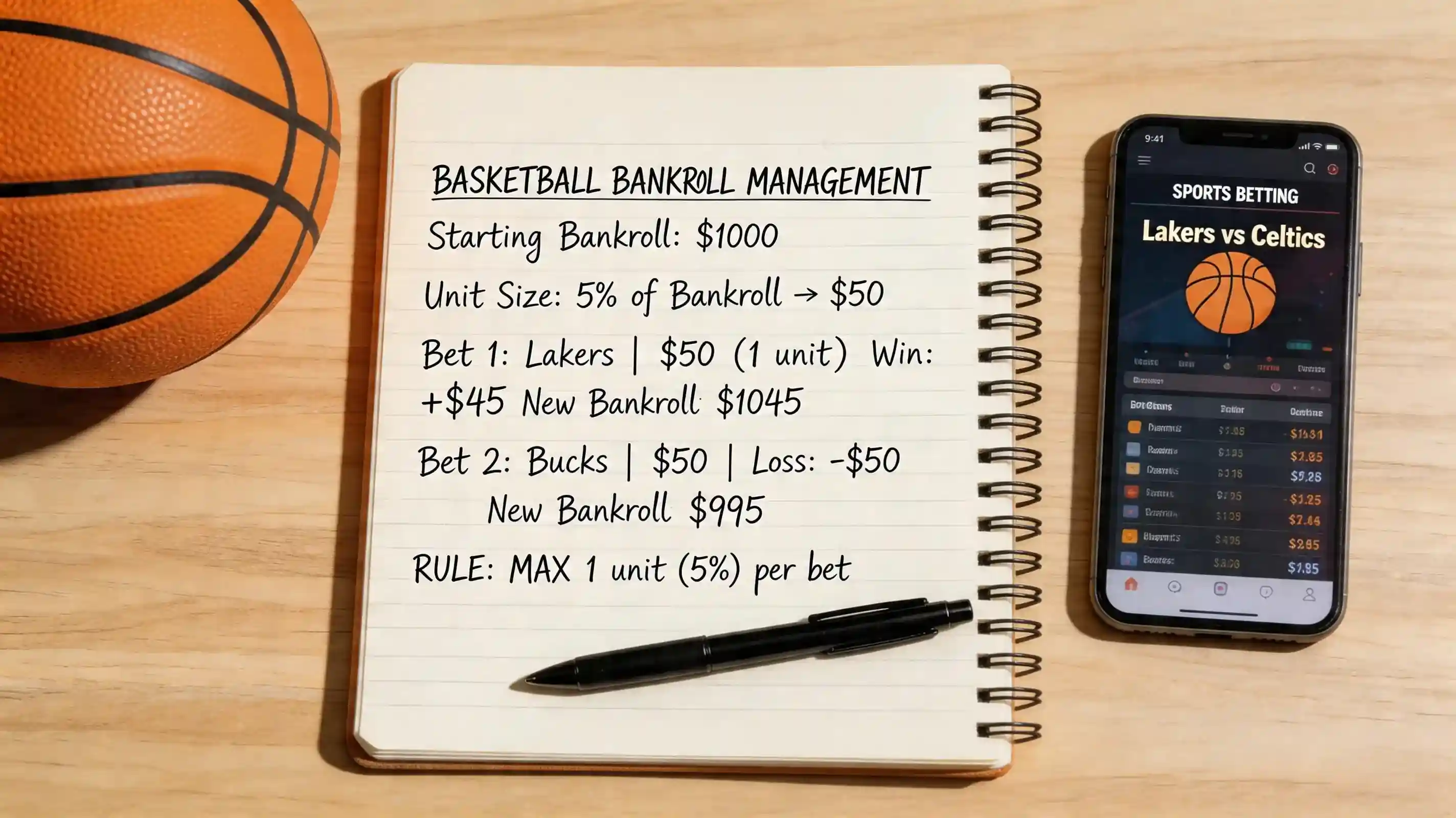
The best bet I ever made was recognising I needed a system. For years, I’d bet whatever felt right — fifty quid when confident, a tenner when uncertain, sometimes nothing, sometimes far too much. My results oscillated wildly despite genuine analytical edge. The problem wasn’t my picks; it was my complete absence of bankroll discipline. Fixing that transformed inconsistent outcomes into sustainable returns.
Live bettors face particularly acute bankroll challenges. Research shows dedicated in-play bettors spend nearly double what pre-match bettors do monthly — approximately 1,584 dollars versus 846. That elevated volume, combined with basketball’s rapid game flow and the psychological intensity of live betting, creates conditions where bankrolls can evaporate faster than reasoned analysis would suggest possible.
Utilising Offensive Rating and Pace for Betting
The unit system converts betting into consistent, measurable activity. Rather than betting arbitrary amounts, you define a standard unit — typically 1-2% of your total bankroll — and stake multiples of that unit based on confidence and edge assessment.
Choosing unit size involves balancing growth potential against ruin risk. Larger units accelerate bankroll growth when winning but also accelerate losses when losing. Smaller units smooth variance but require longer timeframes to generate meaningful returns. Most professional approaches settle on 1-2% as the sustainable middle ground.
Bankroll definition matters more than people acknowledge. Your betting bankroll should be money genuinely available for betting — not rent money, not emergency funds, not money needed for anything else. Mixing betting funds with essential finances creates pressure that distorts decision-making and can lead to catastrophic outcomes.
Recalculating units periodically keeps stakes proportional to current bankroll. After a 20% drawdown, your 2% unit should be 20% smaller in absolute terms. After significant growth, units can increase. This dynamic adjustment prevents winning streaks from inflating stakes to unsustainable levels and losing streaks from depleting bankrolls through oversized relative positions.
Confidence-based unit scaling — betting 2 units on strong conviction plays versus 1 unit on speculative positions — requires honest self-assessment of your ability to distinguish high-edge from low-edge situations. Many bettors overestimate their predictive calibration, betting heavily on what feel like certainties but are actually coin flips.
Staking Plans
Flat staking — betting the same amount on every play regardless of odds or confidence — offers simplicity and psychological stability. You never need to decide how much; you just decide whether. This removes a decision point that can introduce errors and emotional distortions.
Kelly criterion provides a mathematical framework for optimal stake sizing based on edge magnitude. The formula suggests betting a fraction of bankroll equal to edge divided by odds minus one. Full Kelly maximises long-term growth but produces extreme variance; most practitioners use fractional Kelly (half or quarter) to moderate volatility.
Kelly requires accurate edge estimation, which is the hard part of betting. Overestimating your edge leads Kelly to suggest stakes that accelerate ruin rather than growth. Unless your probability assessments have been validated across hundreds of bets with positive results, approach Kelly with caution.
Proportional staking adjusts stake size based on odds: betting more at short odds and less at long odds to normalise potential profit. This approach makes sense if you believe your edge percentage is consistent across odds ranges, but evidence suggests most bettors’ edges concentrate in specific odds bands.
Progressive systems — Martingale, Fibonacci, and similar doubling approaches — promise guaranteed profits through stake escalation after losses. They deliver short-term wins and long-term ruin. Avoid them entirely; the mathematics are clear and unfavourable.
Variance Management
Variance is the gap between expected outcomes and actual outcomes over finite samples. Even skilled bettors with genuine edges experience losing months; unskilled bettors occasionally enjoy winning streaks that obscure their negative expectation. Understanding variance prevents both false despair and false confidence.
Calculating expected variance for your betting profile helps set realistic expectations. A bettor making 100 bets per month at 55% win rate on -110 odds will experience losing months roughly 15% of the time. Knowing this prevents panicked strategy abandonment during inevitable cold stretches.
Drawdown tolerance should inform position sizing. If a 30% drawdown would cause you to abandon your approach or make irrational decisions, size positions such that 30% drawdowns are unlikely even during extended cold runs. Psychological sustainability matters as much as mathematical optimisation.
Diversification across bet types reduces variance somewhat. Mixing spreads, totals, and player props across multiple games creates a portfolio effect that smooths individual bet volatility. Concentration in a single game or bet type amplifies variance even if expected value remains constant.
Tracking results over meaningful samples reveals whether your edge is real. Thirty bets tells you almost nothing; three hundred starts to reveal patterns; three thousand provides reasonable confidence. Most bettors draw conclusions from sample sizes that statistical analysis would consider meaningless.
Closing line value offers a variance-independent skill measure. If you consistently beat the closing line — betting at +150 when games close at +130 — you’re demonstrating edge regardless of short-term win/loss results. This metric helps distinguish skill from luck during hot streaks and cold runs alike.
Session Discipline
Live basketball betting’s continuous nature makes session discipline particularly important. Unlike pre-game betting where you place bets and wait, live betting offers constant opportunities that can extend sessions indefinitely.
Setting session loss limits before starting protects against tilt cascades. “I’ll stop if I lose 5 units tonight” creates a circuit breaker that prevents catastrophic sessions. The limit should be low enough to trigger before emotional decision-making fully takes over.
Win limits seem counterintuitive but serve psychological purposes. “I’ll stop if I win 10 units” locks in successful sessions rather than risking profits on increasingly marginal opportunities. The temptation to “let it ride” after early wins often leads to giving back gains.
Time limits address fatigue-induced errors. Three hours of intense live betting degrades decision quality regardless of results. Setting a maximum session length prevents the late-night bets that frequently undo earlier discipline.
Post-session review identifies patterns that in-session awareness misses. Did you increase stakes after losses? Did you bet more frequently when winning? Did certain game situations trigger impulsive decisions? Reviewing betting logs surfaces tendencies that real-time self-monitoring might miss.
For strategic applications of disciplined bankroll management to specific game situations, live basketball betting fundamentals contextualises staking within broader decision-making frameworks.
How much of my bankroll should I bet per basketball wager?
Most sustainable approaches recommend 1-2% of bankroll per bet. This percentage balances growth potential against ruin risk. Larger units accelerate both gains and losses; smaller units smooth variance but require longer timeframes. Recalculate unit size periodically as bankroll changes to maintain proportional exposure.
What staking plan works best for live basketball betting?
Flat staking — the same amount on every bet — offers simplicity and psychological stability ideal for live betting’s rapid decisions. Kelly criterion optimises mathematically but requires accurate edge estimation that most bettors can’t reliably provide. Avoid progressive systems like Martingale; their long-term mathematics guarantee ruin.
Prepared by the Live Basketball Betting editorial staff.